
November 3, 2025
Between Two Worlds
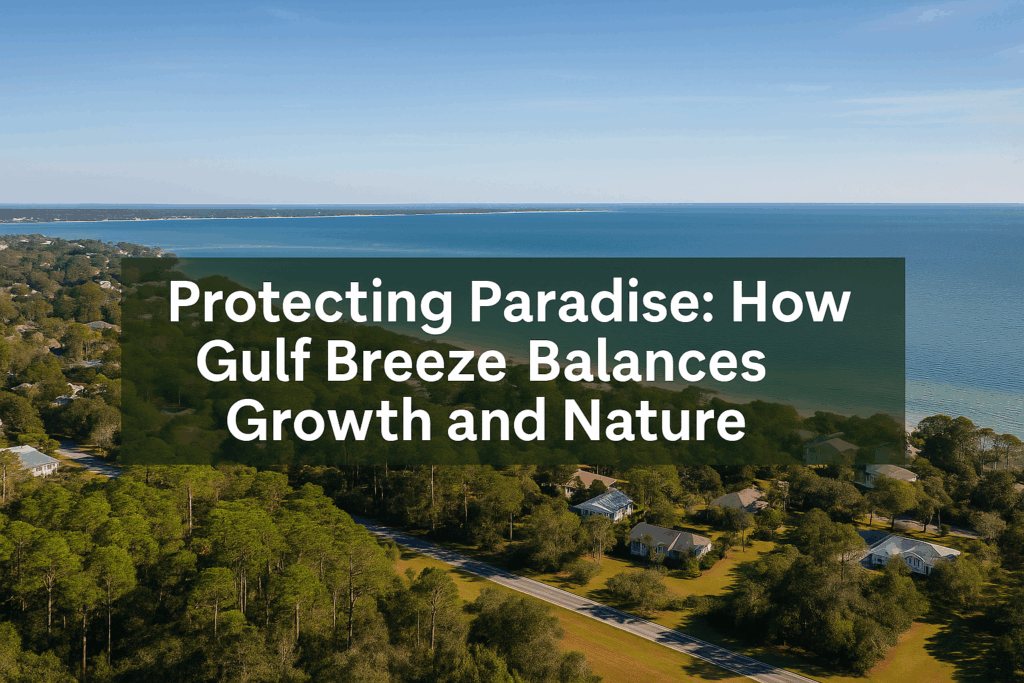
Gulf Breeze sits on a narrow peninsula — a ribbon of land between the wide waters of Pensacola Bay and the open Gulf of Mexico. From above, it looks almost fragile: pine forests and sandy ridges surrounded by endless blue. Yet it’s this delicate geography that gives the town its strength, its identity, and its challenge.
How do you build a thriving community without breaking the ecosystem that defines it?
That question isn’t new here. Gulf Breeze has spent decades learning to live with its environment rather than over it. Growth happens, of course — new homes, new shops, new visitors — but it happens with a certain reverence, as if the town itself remembers who was here first: the tides, the trees, the herons, and the slow, patient curve of the bay.
A Landscape That Demands Respect
To understand Gulf Breeze’s environmental story, you have to start with its setting.
The peninsula is part of the Santa Rosa Barrier System, a network of sand dunes, salt marshes, and pine flatwoods that act like nature’s shock absorbers — filtering water, absorbing storms, and sheltering wildlife. The soil here is thin, sandy, and porous. The water is everywhere: underfoot, on the horizon, and in the air.
Every rainfall becomes part of a conversation between land and sea. And in that conversation, balance is everything.
That’s why Gulf Breeze has always treated its environment as more than scenery — it’s infrastructure. The forests and marshes protect homes from flooding. The seagrass meadows anchor the bay floor and keep the water clear. The dunes hold back the Gulf itself.
Lose those, and you lose more than beauty — you lose protection.
The Push and Pull of Progress
Like much of Florida’s Gulf Coast, Gulf Breeze faces a familiar tension: how to grow without eroding what makes it special.
In recent years, population and tourism have increased steadily. With its proximity to Pensacola Beach, Navarre, and South Walton, the town is now part of a corridor of growth stretching across the Emerald Coast.
But Gulf Breeze has taken a distinctly careful approach. Development here doesn’t race ahead — it inches forward. Zoning laws restrict height and density. Tree ordinances require preservation or replanting. Wetland protection remains strict, even as demand for new lots rises.
As Mayor and longtime residents often note in local forums, “Progress here happens in pencil, not permanent marker.”
It’s a delicate equilibrium — and one the town is determined to keep.
Preserving the Green Heart: Naval Live Oaks Reserve
No discussion of Gulf Breeze’s environmental legacy is complete without mentioning the Naval Live Oaks Reservation, the first federally protected tree farm in U.S. history.
Established in 1828 to supply the Navy with live oak timber for shipbuilding, it has since become a 1,300-acre preserve managed by the Gulf Islands National Seashore. Today, it’s a living classroom where locals hike beneath centuries-old oaks and watch osprey nests sway above the bay.
But beyond its beauty, Naval Live Oaks serves a modern purpose: it’s a natural barrier. The forest’s root systems stabilize the soil, reduce runoff, and prevent erosion along the bayfront. When tropical storms roll through, these trees are the first line of defense.
The fact that this historic reserve still stands — untouched by condos or asphalt — speaks volumes about the region’s values. In Gulf Breeze, conservation isn’t nostalgia. It’s policy.
Shoreline Park: The Town’s Front Porch
Closer to downtown Gulf Breeze, Shoreline Park plays a similar role on a community scale.
Locals call it “the town’s front porch” — a mix of walking trails, kayak launches, and quiet picnic areas shaded by pines and oaks. From the boardwalk, you can see dolphins playing in the bay, fishermen wading knee-deep in the shallows, and families picnicking in the same spot every weekend.
But what’s less visible is how much the park does for the environment. Its natural shoreline acts as a buffer, filtering runoff before it enters the bay. Native plants like cordgrass and needle rush absorb excess nutrients, keeping algae blooms at bay.
The city’s maintenance teams and volunteer groups regularly remove invasive species and plant new native vegetation — small acts that add up to long-term resilience.
The Bay as a Mirror
If Gulf Breeze has a soul, it’s the bay.
Pensacola Bay reflects everything that happens here: the tides, the weather, the choices people make. When rainfall runs off rooftops, it finds its way here. When seagrass grows healthy and thick, it’s a sign that the ecosystem is working.
The city partners closely with regional programs like the Pensacola & Perdido Bays Estuary Program, which monitors water quality, sediment, and marine life. Recent studies show that restoration efforts are paying off — seagrass coverage has expanded, oyster beds are recovering, and water clarity is improving.
Every clearer tide is a quiet victory for a town that refuses to treat its bay as an afterthought.
Building for the Future
Sustainability in Gulf Breeze isn’t just about protecting what exists; it’s about designing what comes next.
New public projects incorporate green infrastructure — things like permeable pavement, bioswales, and rain gardens that let stormwater soak naturally back into the ground. City planners prioritize low-impact development, especially near wetlands and bayfront zones.
Residential neighborhoods increasingly adopt native landscaping — not just for aesthetics, but for function. Native plants need less water, resist pests naturally, and provide habitat for pollinators and birds.
Even small changes add up. Across town, homeowners are replacing manicured lawns with coastal wildflowers, installing rain barrels, and reducing fertilizer use to keep runoff clean. It’s not regulation — it’s culture.
Community at the Core
If Gulf Breeze has one advantage in its environmental journey, it’s the strength of its community.
Groups like Keep Santa Rosa Beautiful, local schools, and volunteer organizations host regular cleanup days, tree-planting events, and educational programs. Children here don’t just learn about the bay in science class — they visit it, test its water, and plant grasses to protect it.
The city’s leadership has long believed that conservation is strongest when it’s personal. When residents see the results of their stewardship — a healthy dune, a clean shoreline, a dolphin sighting — it reinforces the connection between everyday choices and long-term preservation.
Hurricanes and Hard Lessons
Nature also keeps Gulf Breeze humble.
In 2020, Hurricane Sally reminded residents how fragile coastal life can be. Shorelines eroded, trees fell, and infrastructure strained under the surge. But in the aftermath, something remarkable happened: rebuilding efforts leaned greener.
Instead of bulkheads, many property owners installed living shorelines — stretches of native vegetation and oyster reefs that stabilize banks naturally. The city supported restoration projects that used nature-based solutions rather than concrete walls.
Each storm teaches the same lesson: the more you work with the environment, the better it works for you.
The Beauty in Restraint
Perhaps the most admirable thing about Gulf Breeze’s environmental story is its restraint.
In a state where overdevelopment often wins, this community has learned the value of enough. Enough housing to thrive, enough tourism to sustain, enough open space to breathe.
Progress isn’t measured by how much land is used, but by how much is preserved.
The result is a town that feels both alive and peaceful — modern but mindful. On any given day, you might pass a new local café beside a stand of untouched pines, or hear construction on one block and birdsong on the next. It’s a balance few coastal towns manage to hold.
Looking Ahead: The Next Chapter
As Gulf Breeze looks toward its future, the priorities remain clear:
- Keep growth local and intentional.
- Protect water quality and green spaces.
- Educate the next generation of stewards.
The city continues to collaborate with conservation groups and scientists to track progress and adapt. Climate resilience plans are already in place, designed to protect both people and ecosystems from rising seas and stronger storms.
It’s not a fight against nature — it’s a partnership with it.
Frequently Asked Questions
Q: How does Gulf Breeze protect its wetlands and bay?
A: Through strict zoning, green infrastructure, and partnership with the Pensacola & Perdido Bays Estuary Program to monitor and restore local ecosystems.
Q: Can visitors explore natural areas in Gulf Breeze?
A: Absolutely. Naval Live Oaks, Shoreline Park, and the Gulf Islands National Seashore all offer hiking, kayaking, and birdwatching opportunities.
Q: What is a “living shoreline”?
A: It’s an erosion control method that uses native plants, oyster shells, and natural barriers instead of concrete to protect coastal property.
Q: How can residents help with conservation?
A: By using native landscaping, reducing runoff, joining local cleanup events, and supporting sustainability initiatives.
Q: Why is environmental balance so important in Gulf Breeze?
A: Because the town’s safety, beauty, and economy all depend on the health of its natural systems — from forests to seagrass beds.